
Hi! I’m Emma, your American accent and communication coach
And today, we’re talking about something very small that makes a very big difference in professional English: your greeting.
If you’re a non-native English speaker working in the U.S. (or with Americans), this question comes up all the time:
“Is it okay to say hey at work?”
“Does hello sound too formal?”
“Why do Americans seem relaxed—but also judgmental—about greetings?”
You’re not imagining it.
That first word you say can instantly shape how professional, confident, or serious you sound—before you’ve even finished your sentence.
Let’s break this down clearly, practically, and honestly—like a real workplace coach would.
Noted: This article is adapted from training material used in the ChatterFox Business English Course. Check it out here:
https://chatterfox.com/business-english-course/
Why Greetings Matter More Than You Think
In American workplace culture, greetings are not just polite sounds. They’re signals.
They quietly answer questions like:
-
Do you respect this situation?
-
Do you understand workplace norms?
-
Are you professional… or too casual?
Many of my students speak fluent English—but still get subtle feedback like:
-
“You sound a bit informal”
-
“Let’s keep it professional”
-
Or worse… no feedback at all
And often, the problem starts with just one word.

Why Non-Native Speakers Often Sound “Too Casual”
Here’s the real reason this happens (and it’s not your fault).
1. Social Media English ≠ Workplace English
TikTok, YouTube, Netflix, and Instagram are full of:
-
“Hey guys!”
-
“Hey, what’s up?”
-
“Hey bro!”
That English is real, but it’s context-specific.
It works for:
-
Friends
-
Influencers
-
Entertainment
It does not always work for:
-
Job interviews
-
First meetings
-
Emails to managers
-
Client calls
2. You’re Copying the Wrong Models
A great question I ask my students is:
“Whose English are you copying?”
If your goal is career growth, your models should be:
-
Managers
-
Team leads
-
Executives
-
Professionals you respect
Not movie characters.
Not influencers.
Not casual YouTubers.
Let’s Compare the Three Greetings Clearly
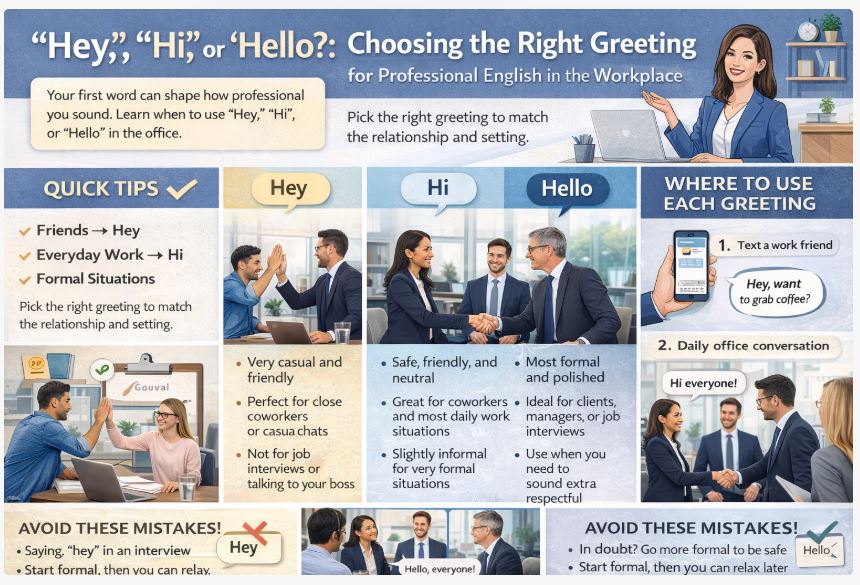
“Hey” — Friendly but Risky
“Hey” is relaxed, informal, and emotionally warm.
In the right situation, it’s totally fine.
In the wrong one, it can quietly hurt your image.
When “Hey” Works
✅ Close coworkers you already know well
✅ Slack or Teams chats with peers
✅ Friendly texts
Examples:
-
“Hey, are you free later?”
-
“Hey! Thanks for the update.”
When “Hey” Can Hurt
- Job interviews
- First meetings
- Emails to managers or clients
Some American professionals do judge this—silently.
One recruiter once told me:
“Starting an interview with ‘hey’ feels like wearing sneakers to a formal meeting.”
“Hi” — The Safest Choice
If English had a neutral setting, it would be “hi.”
It’s:
-
Polite ✔️
-
Friendly ✔️
-
Professional ✔️
-
Flexible ✔️
This is why I recommend “hi” to most learners as their default workplace greeting.
When to Use “Hi”
✅ Coworkers
✅ Managers you already know
✅ Casual professional emails
✅ Meetings with familiar clients
Examples:
-
“Hi Sarah, thanks for your message.”
-
“Hi everyone, good morning.”
-
“Hi, nice to meet you!”
⚠️ One note:
In very formal emails, “hi” can feel slightly casual—but it’s rarely wrong.
“Hello” — Polished and Professional
“Hello” is the most formal of the three—but don’t confuse formal with cold.
Think of hello as:
- A business jacket
- Calm, confident professionalism
When “Hello” Is the Best Choice
✅ Job interviews
✅ First meetings
✅ Speaking to senior leadership
✅ Formal emails or presentations
Examples:
-
“Hello, it’s a pleasure to meet you.”
-
“Hello Mr. Thompson, thank you for your time.”
-
“Hello everyone, thank you for joining.”
⚠️ When not to use it:
With close coworkers, “hello” can sound stiff or distant.
Real Workplace Scenarios (This Is Where It Clicks)
Let’s put these greetings into real situations
| Situation | Best Greeting |
|---|---|
| Texting a work friend | “Hey” |
| Daily office conversation | “Hi” |
| First Zoom call with leadership | “Hello” |
| Job interview | “Hello” |
| Email to your manager | “Hi” |
| Client you just met | “Hello” |
Context matters more than the word itself.
The Simple Rule I Teach All My Students
If you remember nothing else, remember this
Friends → “Hey”
Everyday work → “Hi”
Formal moments → “Hello”
That rule alone will save you from so many awkward moments.
Common Mistakes I Hear from Learners
Let’s fix these quickly ➡️✅
❌ “Hey” in a Job Interview
Even if the interviewer sounds relaxed—don’t mirror too fast.
Start formal. You can relax later.
❌ Overthinking “Hello”
Some learners avoid “hello” because it feels “too much.”
In American English, hello is respectful—not old-fashioned.
❌ Being Casual Too Soon
American culture values friendliness—but professional distance comes first.
Warmth grows over time.
Practice: Train Your Flexibility
Here’s a quick exercise I give my students
Say these out loud:
-
“Hey, how’s it going?”
-
“Hi, how are you today?”
-
“Hello, it’s great to meet you.”
Notice:
-
Your tone changes
-
Your posture changes
-
Your mindset changes
That’s not accidental.
Language shapes behavior.
Final Advice for Professionals and Immigrants
Fluency is not just about grammar or pronunciation.
It’s about judgment.
The most successful professionals I coach are not the ones with perfect accents—but the ones who know how to:
-
Adjust tone
-
Read the room
-
Match the moment
Your greeting is the first signal that you understand how English works in the real world.
Want to Sound More Confident and Professional in English?
At ChatterFox, we help non-native speakers master:
-
Professional tone
-
Workplace English
-
Pronunciation that builds credibility
-
Real-world communication—not textbook English
We combine AI speech feedback with certified American accent coaches, so you don’t just learn rules—you learn how English actually works in daily professional life.
If your goal is confidence, clarity, and career growth, you’re in the right place ✨
Thanks for reading—and remember:
Sometimes, sounding professional starts with just one word.