

Hi, I’m Emma — your American accent coach and business English guide.
Let me guess…
You’re comfortable starting a meeting.
You can introduce yourself.
You can share your ideas.
But when it’s time to end the meeting, you suddenly think:
“What do I say now?”
“How do I close this professionally?”
“How do I confirm next steps without sounding bossy?”
“What if I forget something important?”
If you’re a non-native English speaker, this moment can feel awkward. You don’t want to sound abrupt. You don’t want to sound too casual. And you definitely don’t want to leave without clear action items.
Today, I’m going to show you exactly how to End a Meeting in Business English — politely, confidently, and clearly.
We’ll cover:
Natural closing phrases
How Americans signal a meeting is ending
How to summarize decisions
How to confirm next steps
How to assign responsibilities politely
How to end on a warm, professional note
Full sample scripts you can actually use
Let’s dive in.
Noted: This article is adapted from training material used in the ChatterFox Business English Course.
Check out the course: https://chatterfox.com/business-english-course/
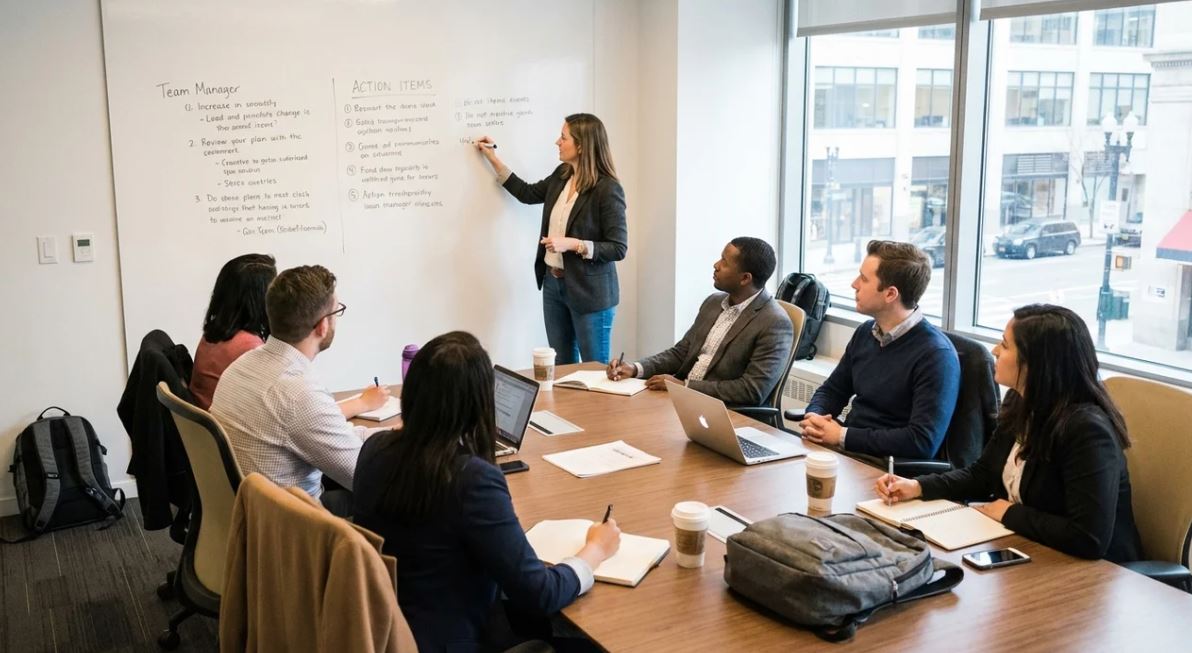
In American business culture, meetings are expected to:
Start on time
Stay focused
End with clarity
If a meeting ends without confirming next steps, it often creates confusion. People may think:
“Wait, who’s doing what?”
“Are we meeting again?”
“Was that decision final?”
A strong closing does three things:
✅ Shows leadership
✅ Creates accountability
✅ Builds professionalism
Even if you’re not the manager, knowing how to End a Meeting in Business English makes you sound organized and confident.
Americans rarely say:
❌ “Okay. Meeting finished.”
❌ “That’s all.”
❌ “We’re done.”
Instead, we use soft transition phrases.
Here are common signals:
“Alright, I think we’ve covered everything.”
“I think that wraps things up.”
“Before we close, let’s quickly review.”
“Just to summarize…”
“Unless anyone has anything else…”
“Any final questions before we wrap up?”
These phrases gently move the conversation toward closing without sounding abrupt.

Here are natural phrases you can use:
“Alright, I think we’ve covered the main points.”
“That brings us to the end of our agenda.”
“I believe that addresses everything for today.”
“I think that wraps things up.”
“Before we conclude, let’s quickly review the action items.”
“If there’s nothing further, we can go ahead and close.”
“Okay, I think we’re in good shape.”
“Looks like we’ve got a plan.”
“Anything else before we wrap up?”
Notice something important:
Americans soften endings with words like:
“I think”
“Looks like”
“Seems like”
This makes you sound collaborative rather than authoritative.
This is where many non-native speakers struggle.
They end the meeting… but forget to summarize.
In American business culture, summarizing is essential.
“Just to recap…”
“So to summarize…”
“Let me quickly go over what we agreed on.”
“Here’s what we decided.”
Then clearly list the points.
“Just to recap, we agreed to move forward with the revised timeline, and we’ll finalize the budget by Friday.”
Short. Clear. Direct.
This is the most important part of how to End a Meeting in Business English.
Americans love clarity.
You should confirm:
Who is responsible
What they’re doing
When it’s due
Instead of saying:
❌ “You will send it.”
❌ “John, do the report.”
Say:
“John, you’ll send the updated report by Thursday.”
“Maria will follow up with the client.”
“I’ll take care of the presentation slides.”
“Let’s plan to review this next Monday.”
Notice how calm and factual this sounds.
Before closing, Americans often invite last comments.
This shows respect and collaboration.
Try:
“Does anyone have anything else to add?”
“Any final thoughts?”
“Any questions before we wrap up?”
“Is everyone clear on the next steps?”
This gives people a safe moment to speak.
Finally, you close with appreciation or encouragement.
Here are professional endings:
“Thanks, everyone.”
“I appreciate your time.”
“Great discussion today.”
“Thanks for your input.”
“Looking forward to next steps.”
“Talk to you all soon.”
Short. Warm. Professional.
Let’s see how this works in a real situation.
Imagine you’re leading a project update meeting.
Here’s a natural American-style ending:
“Alright, I think we’ve covered everything for today.
Just to recap, we’re moving forward with the new launch timeline, and the marketing team will adjust the campaign accordingly.
John, you’ll send the updated budget by Thursday.
Maria, you’ll follow up with the client and confirm the revised deadline.
And I’ll finalize the presentation deck.
Does anyone have anything else to add before we wrap up?
(No response)
Great. Thanks, everyone — really appreciate your time. Let’s reconnect next week to review progress.”
That’s a textbook example of how to End a Meeting in Business English.
Clear. Polite. Organized.
Online meetings (Zoom, Teams, Google Meet) often include technical endings.
You might hear:
“Alright, I’ll go ahead and end the call.”
“Feel free to drop off.”
“I’ll send the follow-up email.”
“Thanks, everyone — have a great rest of your day.”
If you’re the host, you might say:
“Thanks, everyone. I’ll end the meeting here.”

Avoid these direct endings:
❌ “Okay, that’s it.”
❌ “We’re done.”
❌ “Meeting over.”
They sound cold.
American business English prefers soft transitions.
When closing a meeting, your intonation should:
Slightly fall at the end
Sound calm and confident
Avoid sounding rushed
For example:
“Alright, I think that wraps things up.”
The voice gently drops at the end.
Practice saying it slowly and confidently.
Let me share what I hear from my students:
They just stop talking.
They forget to recap decisions.
Everyone leaves confused.
“We hereby conclude this meeting.”
This sounds legal — not natural.
Let’s practice together.
Imagine you’re ending a budget meeting.
Try filling this in:
“Alright, I think we’ve covered _______.
Just to recap, we decided to _______.
John will _______ by Friday.
I’ll _______.
Does anyone have any final questions?
Thanks, everyone.”
Say it out loud.
Practice it until it feels natural.
Fluency comes from repetition.

Reading phrases is helpful.
But real improvement in learning to End a Meeting in American Business English comes from:
Practicing real scenarios
Working on tone and intonation
Getting feedback
Repeating realistic dialogues
Hearing how native professionals close meetings
Structured programs like the ChatterFox Business English Course focus on real workplace situations — including meetings, presentations, and professional communication — with guided practice and feedback.
The key is consistency.
Choose structured practice and repeat until it feels automatic.
Professional fluency isn’t about memorizing phrases.
It’s about sounding calm, clear, and confident under pressure.
Ending a meeting well is not just a small detail.
It’s leadership.
It’s clarity.
It’s professionalism.
When you can:
Signal the close naturally
Summarize clearly
Confirm responsibilities
Invite final input
End warmly
You don’t just speak English.
You communicate like a professional in American business culture.
Practice these phrases.
Say them out loud.
Use them in your next meeting.
And remember — you don’t need perfect English.
You need clear, confident English.
And you’re absolutely capable of that. ????✨