The Complete Guide to Understanding Fast American Speech

Hey — I’m Emily, your American accent coach. And if you’ve ever thought, “I can read English just fine… but when Americans speak, it turns into a blur,” you’re not alone. I hear this exact frustration from students every week.

Here’s the good news: the problem is usually not that Americans speak “too fast.”

The problem is that Americans speak connected.

They link words together, reduce small words, change sounds (hello, “t” ????), and package speech into rhythmic chunks. If you’re listening for “perfect dictionary words,” your brain can’t find the boundaries — so everything sounds like one long sound wave.

This guide will teach you a practical decoding system. Not “listen more.” Not “watch Netflix.” A real method you can use today.

And the biggest mindset shift?

Stop trying to hear every word.
Catch the stressed words first — then your brain fills in the rest. ????

1) Why “Fast English” Feels Impossible

Let’s name the real enemy: audio blur.

When you learned English, you probably learned it in a clean, separated way:

  • textbook sentences
  • clear teacher pronunciation
  • slow audio tracks
  • written words you can “see”

But real American speech is messy — in a predictable way.

Here’s what’s actually happening:

  • words stick together
  • small words shrink
  • sounds change
  • speakers don’t finish every sound
  • meaning is carried by rhythm + stress, not perfect pronunciation

So if your listening strategy is “find every word,” your brain is doing an impossible job.

A better strategy is:
Find the meaning anchors first. (We’ll practice that a lot.)
2) The One Rule That Explains Almost Everything: Stress-Timed Rhythm

American English is stress-timed — which means it runs on beats.

Think of stressed syllables like the beat in music. ????
They are the “anchors” your brain grabs to understand a sentence.

Stress is not random

Most of the stress falls on content words:

  • nouns: meeting, problem, idea
  • main verbs: need, want, fix
  • adjectives: important, ready, late
  • adverbs: quickly, really, basically
  • negatives: not, never

And most function words get reduced:

  • articles: a, the
  • prepositions: to, for, of
  • helpers: do, have, can
  • pronouns: him, them, you
  • conjunctions: and, or, but

A simple example

Dictionary-style (what learners expect):
“I WANT to GO to the STORE.”

Real American speech (what you actually hear):
“I WANTGO tə thə STORE.”

Notice: the meaning words stay strong. The small words shrink into quick soft sounds (often schwa /ə/).

What this means for you (this is huge)

You are supposed to “miss” some sounds.

Not because you’re bad at English — because the language is designed that way.

Your job is not “hear everything.”
Your job is “catch the beats.”

3) Step Zero: Train Your Ear to Hear “Shapes,” Not Words

Skilled listeners don’t track every word. They track:

  • stress peaks (the loud/clear words)
  • intonation (pitch movement that signals meaning)
  • rhythm (fast-slow pattern)
  • chunks (thought groups)

If you listen word-by-word, speech feels like noise.
If you listen chunk-by-chunk, speech starts feeling like meaning.

The “audio blur” problem (why boundaries disappear)

In fast speech, Americans don’t leave clean gaps between words.

So your brain can’t answer:
“Where does one word end and the next begin?”

That’s why it feels like:

  • “whaddayamean”
  • “jeetyet”
  • “kinnagodo”

It’s not your ears. It’s your segmentation system (your brain’s “word-boundary detector”) needing retraining.

Quick self-test: reading vs. real speech gap

Try this:

  1. Read this out loud slowly:
    “I was going to ask you if you wanted to go.”

  2. Now say it like a real American:
    “I wuz gonna askya if ya wanted t’go.”

If you can read it but you can’t hear it, that’s normal — it means you’re missing the fast-speech versions in your listening database.

We’re going to build that database.
4) The Anchor Strategy: Catch the Stressed Words First

This is the skill that changes everything.

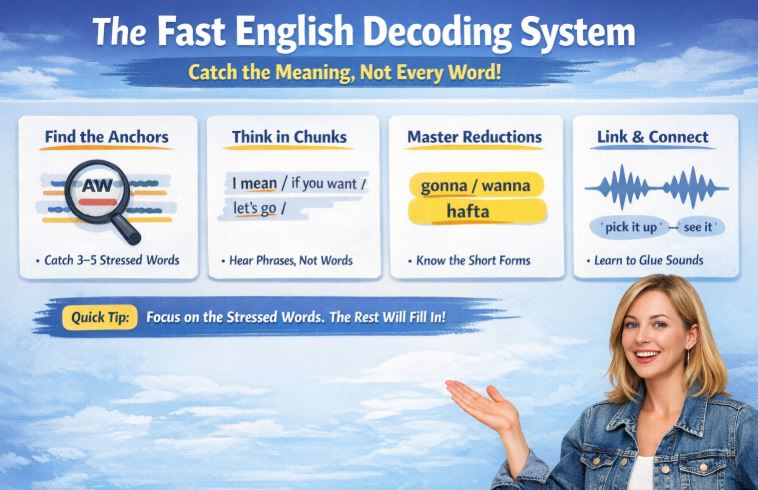
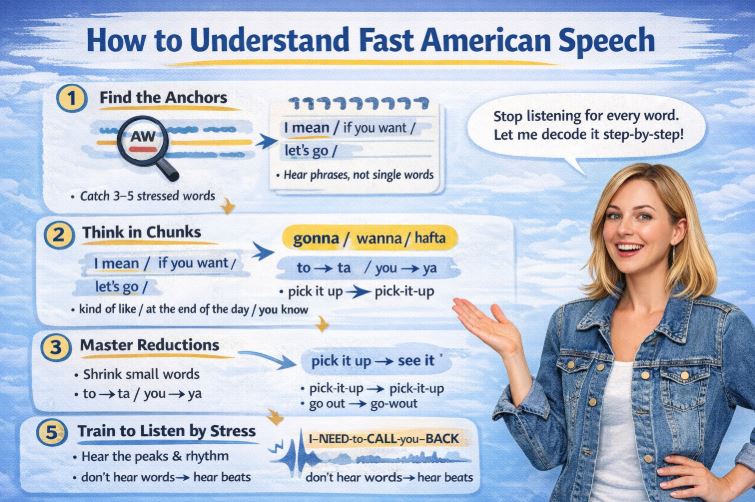
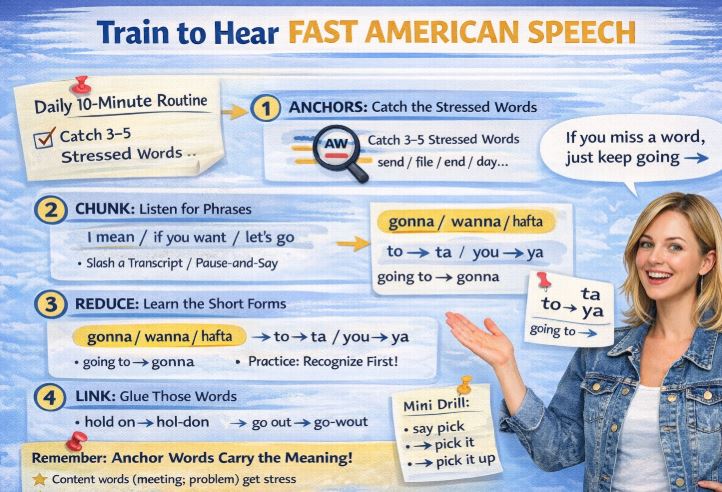
When Americans speak fast, you want to catch 3–5 stressed words — like headlines.

How to identify stressed words in real time

Stressed words usually have:

  • clearer vowel sound
  • slightly longer duration
  • higher pitch or pitch change
  • louder volume
  • more “shape” (you can almost feel them)

Unstressed words are often:

  • quieter
  • faster
  • reduced vowels (schwa)
  • blended into neighbors

The “3–5 word capture” technique

While listening, aim to catch only the headline words.

Example:
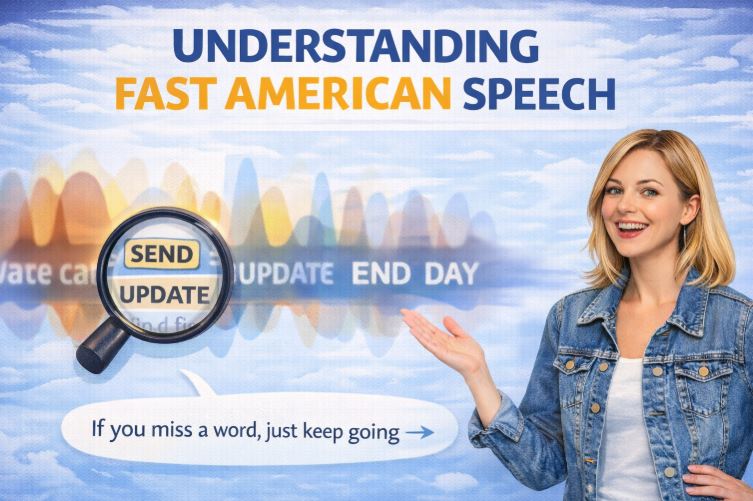
Full sentence: “I’m gonna send you the updated file by the end of the day.”
What you should catch: send / updated / file / end / day

That is enough for meaning.

Exercise 1: stressed-word notes ✍️

  • Play a 10–15 second clip.
  • Don’t pause.
  • Write only stressed words you catch.
  • Stop. Look at your notes.
  • Reconstruct meaning.

Example notes: send / file / end / day
Your brain can fill: “Someone will send a file later today.”

Exercise 2: meaning reconstruction

Do this with a friend, tutor, or even by yourself:

  1. Listen once and write stressed words.
  2. Guess the sentence.
  3. Listen again.
  4. Compare.

Your goal is not “perfect.” Your goal is “meaning.”

Common mistake: stopping to confirm every word

Many learners do this internally:

“Wait… was that can or can’t? Let me check… oh no, I missed the next sentence.”

That’s how you get lost.

New rule:
If you miss a word, keep moving. ????‍♀️
You’ll recover using anchors.

5) Chunking: Hear Phrases, Not Individual Words

Fast speech becomes understandable when you stop hearing “words” and start hearing thought groups.

A thought group is a small meaning package — like a mini sentence inside the sentence.

What a thought group sounds like

Americans speak in chunks like:

  • “I mean…”
  • “The thing is…”
  • “You know…”
  • “Kind of…”
  • “At the end of the day…”

These chunks are often said quickly — but as a unit.

Why chunking matters

Your brain has limited working memory. If you try to hold 12 separate words, it overloads.

But if you hold 2–3 chunks, it’s easy.

Exercise 1: slash practice

Take a short transcript and add slashes where you hear natural chunk breaks:

“I mean / if you want / we can do it tomorrow / no big deal.”

Then listen again and match the chunking.

Exercise 2: pause-and-predict ????

  • Play a clip.
  • Pause after a chunk.
  • Predict the next chunk.

Example: “I mean…”
Your brain predicts: “the thing is…” or “like…” or “it depends…”

This trains you to follow natural American speech patterns. 
6) The Big 5 Connected-Speech Behaviors (The Real “Fast Speech” Toolkit)

Here’s the toolkit. If you learn these five behaviors, “fast speech” stops being mysterious.

6.1 Linking (words glue together)

Americans don’t like “gaps.” They glue words.

Consonant-to-vowel linking

If one word ends in a consonant and the next starts with a vowel, it links:

  • “pick it up” → “pi-ki-dup”
  • “turn it on” → “tur-ni-don”
  • “hold on” → “hol-don”

Mini drill:
Say it slowly, then link it:

  • “pick… it…” → “pickit” → “pickitup”
  • “turn… it…” → “turnit” → “turniton”

Vowel-to-vowel linking (intrusive /y/ and /w/)

When vowels meet, Americans often add a tiny glide:

  • “see it” → “see-yit”
  • “go out” → “go-wout”
  • “I agree” → “I-yagree”

Practice sentences:

  • “I-yasked him already.”
  • “Go-win and sit down.”
  • “She-yis ready.”

Don’t force it too hard — it’s a gentle glide, like a bridge ????.

6.2 Reductions (small words shrink)

This is the #1 reason learners can’t “find” words they already know.

Common reductions:

  • to → /tə/ (“gonna” often lives here)
  • of → /əv/ or /ə/ (“kind of” → “kinda”)
  • and → /ən/ or /n/ (“bread and butter” → “bread-n-butter”)
  • for → /fər/ or /fr/ (“for you” → “frya” sometimes)
  • you → “ya”
  • your → “yer”
  • them → “’em”

Weak forms: schwa takes over

Schwa /ə/ is the lazy, relaxed vowel. Americans love it in unstressed words.

That’s why:

  • “to the” becomes “tə thə”
  • “for a” becomes “fərə”
  • “at a” becomes “ədə”

Practice: full form → real speech

Try these transformations:

  • “want to” → “wanna”
  • “going to” → “gonna”
  • “have to” → “hafta”
  • “got to” → “gotta”
  • “give me” → “gimme”
  • “let me” → “lemme”

A smart way to practice: recognize first, produce second.
Your listening improves faster when you can identify these forms instantly.

6.3 Flap T / D (the “soft d” sound)

This is the classic “Americans don’t say T” misunderstanding.

In many positions, T and D become a flap /ɾ/ — a quick tap sound, like a soft “d.”

Examples:

  • water → “wah-der”
  • better → “beh-der”
  • city → “ci-dy”
  • meeting → “mee-ding”

Why learners lose the word: you’re listening for a crisp /t/ — but you’re hearing /ɾ/.

Listening cues

When do you usually get flap T?

  • between two vowels: wa-ter, ci-ty
  • after an R-colored vowel: par-ty
  • when the next syllable is unstressed: BET-ter

Quick mini-pairs

  • writer vs. rider (often sound similar!)
  • latter vs. ladder (often sound similar!)

Don’t panic — context usually makes the meaning clear.

6.4 Glottal stop + dropped T (especially before consonants)

Sometimes T doesn’t flap — it just disappears or becomes a throat “catch.”

Examples:

  • mountain → “moun’n”
  • important → “impor’ant” (or “impor’n” depending on speaker)
  • internet → “innernet” (very common in casual speech)
  • exactly → “eg-zac-ly” (T often not released)

Where T often isn’t released

  • before consonants: right now, best friend, don’t know
  • at the end of a phrase: I can’t. (often unreleased)

Listening strategy (super important)

Don’t hunt for the T.

Instead, hunt for:

  • the vowel
  • the timing
  • the next consonant

Example: “important”
If you hear: “im-POR-…” and the rhythm fits, your brain fills the missing T.

6.5 Assimilation (sounds change because of neighbors)

Sounds influence each other. This creates “new” forms.

Examples:

  • did you → “didja”
  • don’t you → “doncha”
  • want you → “wantcha”
  • got you → “gotcha”
  • would you → “wouldja”
  • as you → “azha” (sometimes)

Also:

  • want to → wanna
  • going to → gonna
  • got to → gotta

Again: recognition first. Production later. ✅

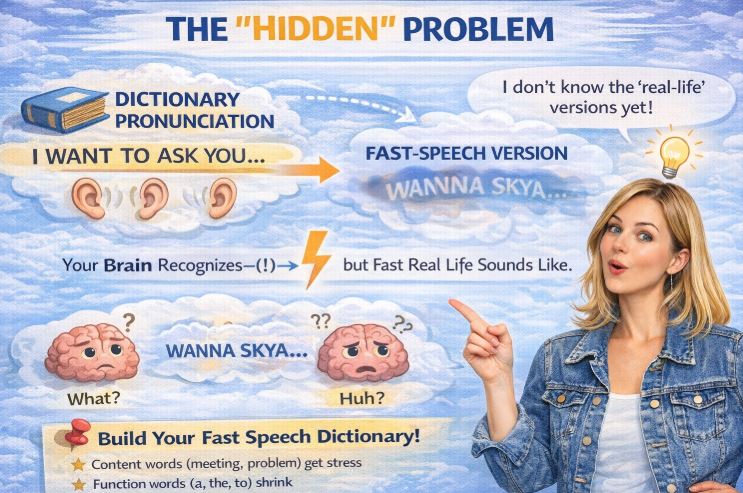
7) The “Hidden” Problem: You Don’t Know the Common Fast-Speech Versions Yet

This is the big truth:

Your brain recognizes dictionary pronunciation
but real life uses fast-speech pronunciation.

So even if you “know the word,” you don’t recognize it when it shows up in a new shape.

Build your “fast speech dictionary”

Start collecting the real-life versions you hear most often.

Here’s a starter list (save it somewhere):

Everyday reductions
  • kinda (kind of)
  • sorta (sort of)
  • lemme (let me)
  • gimme (give me)
  • tell’em (tell them)
  • outta (out of)
  • lotta (lot of)
  • gotta (got to)
  • wanna (want to)
  • gonna (going to)
  • hafta (have to)
  • shoulda / coulda / woulda
  • mighta / musta
  • dunno (don’t know)
  • whaddaya (what do you…)
  • watcha (what are you… / what you…)
  • didja (did you)
  • doncha (don’t you)
  • couldja (could you)
  • wouldja (would you)

Frequent “glue phrases”

  • you know
  • I mean
  • the thing is
  • kind of like
  • at the end of the day
  • to be honest
  • I guess
  • I feel like
  • you wanna (…)
  • do you wanna (…)
  • let’s just (…)
  • a lot of people
  • I don’t think (…)
  • I’m not sure (…)
  • it depends (…)
  • right now
  • in a second
  • pretty much
  • as soon as (…)
  • what I’m saying is (…)

The goal isn’t to memorize 1,000 forms in a day.
The goal is to start noticing them — and turning them into familiar friends instead of scary noise ????.

8) Use Captions the Right Way (So You Don’t Become Caption-Dependent)

Captions can help — or they can trap you.

If you always watch with captions, your brain learns:
“I don’t need to decode sound. I’ll just read.”

So here’s the better method.

The 3-pass method

  1. Audio only: write stressed words (anchors)
  2. Captions on: confirm chunks + reductions
  3. Audio again, no captions: same clip, stronger recognition

This trains your ears and keeps you from becoming dependent.

Slow down without ruining rhythm

If you slow audio too much (like 0.5x), the rhythm changes and reductions become unnatural.

Instead, use:

  • 0.85x–0.9x speed (gentle slow)

Loop one sentence technique ????

Pick one sentence (5–8 seconds) and loop it 10–20 times.

Looping is not boring when you’re doing it with a mission:

  • first loop: anchors
  • next loops: chunking
  • next loops: reductions
  • final loops: shadowing

9) A Practical Training System (10 Minutes a Day)

Consistency beats intensity. Ten minutes daily is enough if you practice the right way.

Your 10-minute plan

Minute 1: Rhythm warm-up
Tap the beat while saying:
I NEED to CALL you BACK.” (tap on NEED/CALL/BACK)

Minutes 2–3: Anchor capture
Listen to a short clip and write 3–5 stressed words.

Minutes 4–5: Chunking
Listen again and mark thought groups (slashes).

Minutes 6–7: One connected-speech pattern
Pick one: linking, reductions, flap T, dropped T, assimilation.

Minutes 8–10: Quick shadowing
Shadow the same clip (we’ll do this properly next section).

How to choose the right audio

Pick audio that is:

  • interesting enough to repeat (important!)
  • slightly challenging, not impossible
  • 10–30 seconds long for drilling

Good sources:

  • YouTube interviews
  • podcasts with clear speakers
  • TV scenes with normal conversation
    meeting clips / business English clips if that’s your goal

10) Shadowing for Listening (Not Just Pronunciation)

Most people think shadowing is “pronunciation practice.”

But shadowing is also listening training — because it forces your brain to stay with the speaker in real time.

What shadowing is (and isn’t)

Shadowing is:

  • repeating along with audio to match rhythm and flow

Shadowing is not:

  • reading and speaking separately
    perfect pronunciation practice
  • memorizing

The delayed shadow method

Repeat 1–2 words behind the speaker.

Example:
Speaker: “So I was gonna call you…”
You (slightly behind): “…gonna call you…”

This trains real-time processing.

The mumble shadow method (my favorite)

First, don’t try to copy exact sounds.

Copy only:

  • rhythm
  • stress
  • melody

You literally “mumble” the shapes like:
“duh DUH duh DUH-duh…”

This removes pressure and builds the foundation fast ????.

Track progress without overthinking

Every week, test yourself with the same clip:

  • How many anchors can you catch on the first listen?
  • Do reductions sound more familiar?
  • Do you lose fewer words after you miss one?

Progress often feels subtle — until one day you realize you’re understanding way more without trying.

11) Real-World Scenarios: How Fast Speech Changes by Situation

Fast speech isn’t one thing. It changes depending on context.

Casual chat

More:

  • reductions
  • slang
  • dropped sounds
  • overlapping speech

Listen for:

  • emotions (stress shifts!)
  • “glue phrases” like you know / I mean

Meetings

More:

  • clearer structure
  • repeated key nouns
  • slower than casual chat (usually)

Listen for:

  • nouns (projects, numbers, deliverables)
  • decisions (“we’re going to…”)
  • dates/times (“by Friday,” “next week”)

Phone calls

Harder because:

  • no visual cues
  • audio quality issues
  • names/numbers get swallowed

Listen for:

  • names
  • numbers
  • action steps (“I’ll send…”, “please confirm…”)

Storytelling (people often speak fastest here)

When people get excited, they speed up and connect more.

Listen for:

  • sequence words: then, so, after that
  • stressed verbs: went, saw, told, happened

12) Troubleshooting: Why You Still Can’t Understand (And Fixes)

Let’s fix the most common pain points.

“I know the words but can’t hear them”

That’s usually a reduction/connected-speech gap.

Fix:

  • study reductions daily (to/of/and/you/your)
  • loop one sentence and identify 2–3 reduced words

“I get lost after one missed word”

That’s an anchor + chunking skill issue.

Fix:

  • practice 3–5 word capture
  • force yourself to keep going (no mental rewinding)

“Different accents throw me off”

That’s normal. Your brain is pattern-matching.

Fix: controlled exposure plan:

  • 80% one accent (General American)
  • 20% variety (Southern, NYC, international speakers)

“My vocab is fine but listening is bad”

That means you have knowledge, not recognition.

Knowing a word on paper doesn’t mean recognizing it in a blur.

Fix:

  • build your fast-speech dictionary
  • do audio-only anchor capture daily

13) A 30-Day Progress Plan (Beginner / Intermediate / Advanced)

Here’s a realistic plan that works if you stay consistent.

Week 1: Anchors + thought groups

Daily:

  • 3–5 word capture
  • slash chunking
    Checkpoint:
  • can you summarize a clip from anchors?

Week 2: Reductions + linking

Daily:

  • reduction focus (to/of/and/you)
  • linking drills
    Checkpoint:
  • can you recognize “gonna / wanna / hafta” instantly?

Week 3: Flap T + assimilation

Daily:

  • flap T recognition (water, better, city)
  • didja/doncha forms
    Checkpoint:
  • do these words still “disappear,” or do they sound normal now?

Week 4: Speed + real-world audio

Daily:

  • 0.9x → 1.0x practice
  • short real-life clips (calls, meetings, casual)
    Checkpoint:
  • can you follow a 20–30 second clip with fewer pauses?

14) Quick Reference: Fast Speech Cheat Sheet

What to do while listening (3 rules)

  1. Catch stressed words first (anchors)
  2. Listen in chunks (thought groups)
  3. If you miss a word, keep moving (recover with context)

Top reductions to recognize

  • to → tə
  • of → ə / əv
  • and → n / ən
  • you → ya
  • your → yer
  • them → ’em
  • going to → gonna
  • want to → wanna
  • have to → hafta

Top linking patterns

  • consonant + vowel: “pick it up” → “pickitup”
  • vowel + vowel: “go out” → “go-wout”
  • “see it” → “see-yit”

If you miss a word, do this instead…

  • don’t rewind mentally ❌
  • grab the next stressed word ✅
  • rebuild meaning from anchors ✅

15) FAQ

Should I slow audio down?

Yes — but slightly.
Use 0.85–0.9x, not 0.5x, so the rhythm stays natural.

Do I need to learn IPA?

Not required. IPA can help you notice patterns (like flap T), but you can improve a lot without it. If IPA stresses you out, skip it.

Why do Americans “skip” sounds?

They’re not skipping meaning — they’re reducing unstressed parts to keep rhythm smooth. Stress carries meaning; reductions keep speed and flow.

How long until I improve?

If you practice 10 minutes a day with the system in this guide, many learners feel real improvement in 2–4 weeks — especially with anchor capture and reductions. Big jumps often happen around the 30-day mark.

What content is best (podcasts, YouTube, TV, calls)?

Best choices depend on your goal:

  • daily conversation → YouTube vlogs, interviews
  • workplace English → meeting clips, business podcasts
  • phone clarity → customer-service style calls, voicemail clips

Pick content you can loop without suffering ???? — repetition is the magic.

Final thoughts

Understanding fast American speech is not a talent. It’s a trainable skill.

When you stop trying to hear every word and start listening for stress + chunks + patterns, your brain finally gets the clues it was missing.

So start simple:

Today: catch 3–5 stressed words from one short clip.
Tomorrow: add chunking.
This week: learn 10 common reductions.
Next week: flap T and linking won’t feel scary anymore.

And if you want extra structure, tools that let you loop sentences, track your improvement, and get feedback (including AI speech recognition + support from certified accent coaches) can make the process smoother — that’s exactly how programs like ChatterFox are designed to help, especially when you’re training both listening and speaking skills together. ????

You’ve got this. One “audio blur” at a time.

 

Seach the blog
Fluency Challenge